
IV. Core Workflows Supported by Epic Anesthesia
A) Pre-Operative Assessment and Preparation
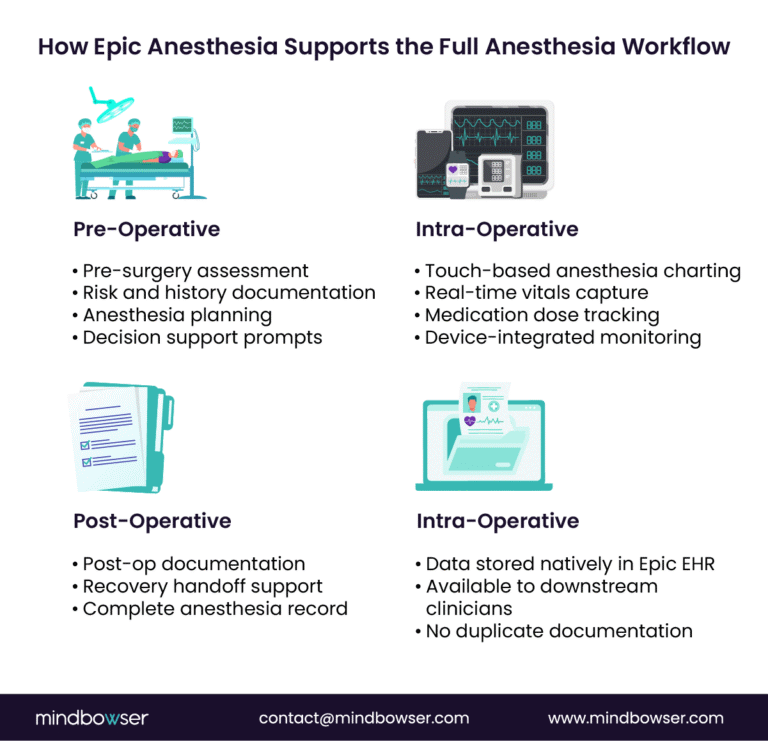
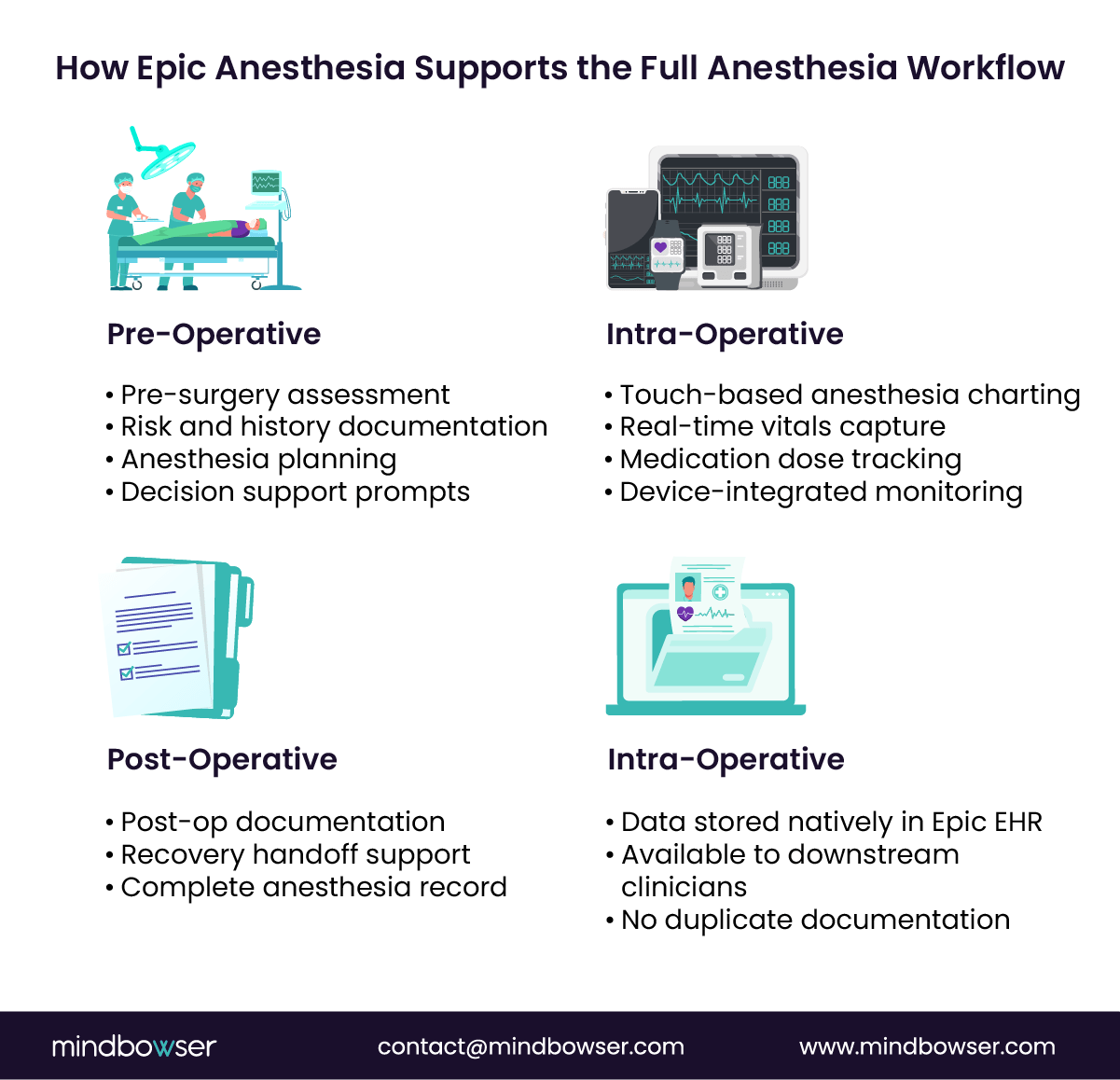
Epic Anesthesia supports structured pre-operative workflows that help clinicians assess patient readiness before surgery begins. The Epic Anesthesia module includes pre-surgery assessment tools and documentation aids that capture patient history, risk factors, and anesthesia plans directly within the Epic EHR. This ensures anesthesia teams start each case with a complete, accessible record and reduces last-minute information gaps that can delay induction or increase risk.
B) Intra-Operative Epic Anesthesia Charting
During surgery, Epic Anesthesia charting becomes the system of record for anesthesia care delivery. The platform tracks medication doses, captures physiologic data in real time, and supports accurate documentation throughout the case. Touch-optimized interfaces enable anesthesiologists to chart quickly while staying focused on the patient rather than the workstation. Integrated device data strengthens accuracy and supports safer intra-operative decision-making.
C) Post-Operative Documentation and Recovery
After the procedure, Epic Anesthesia provides post-op documentation tools that support handoff to recovery teams and ensure continuity of care. All anesthesia records remain native to the Epic EHRenabling downstream clinicians to access complete anesthesia data without reconciliation or duplicate entry.
D) Medical Device Integration
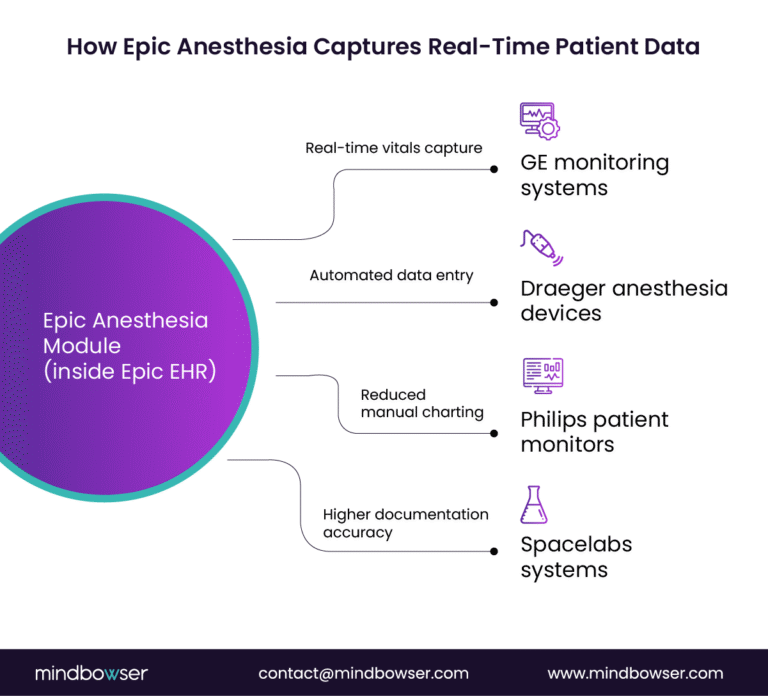
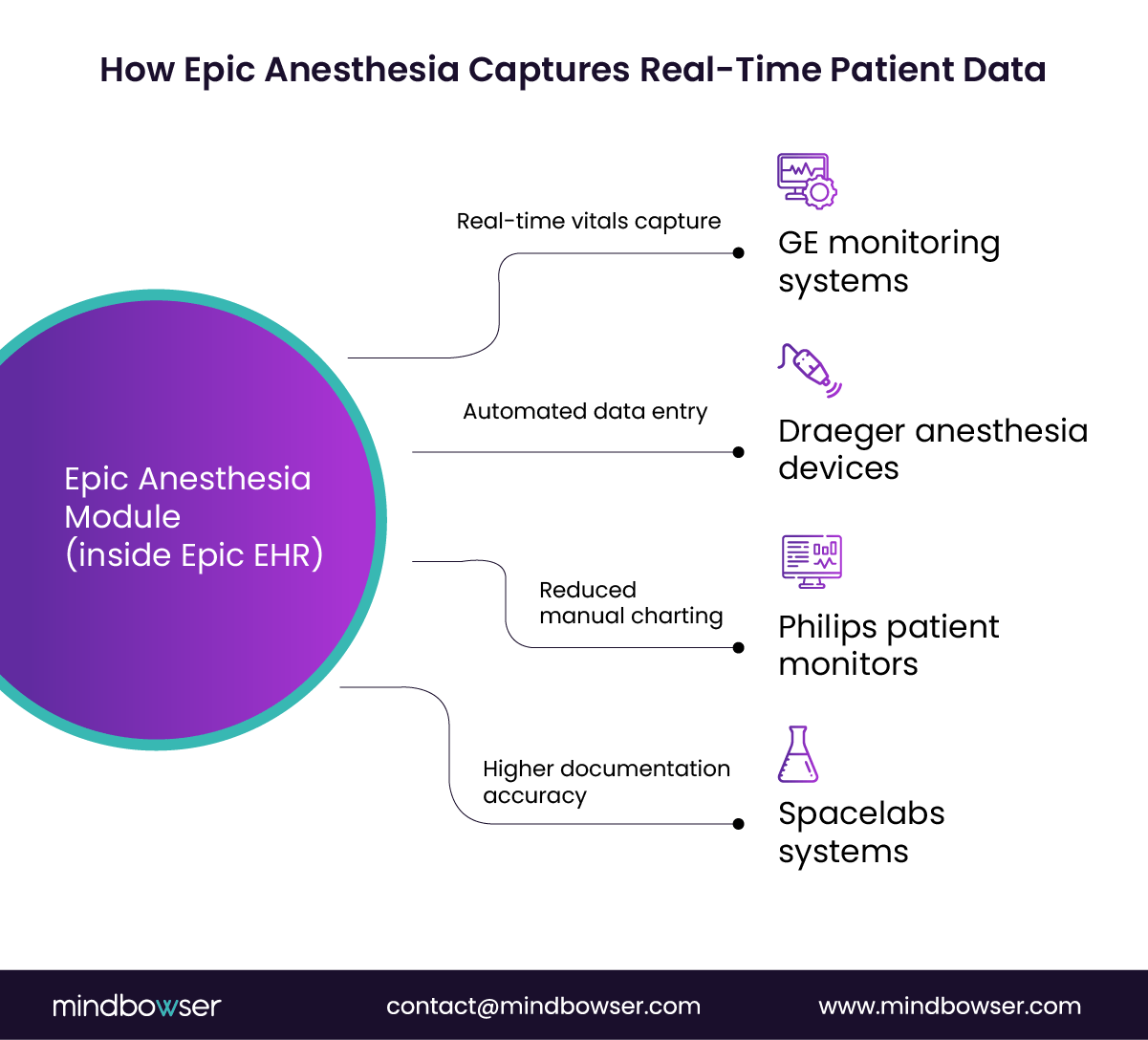
Epic Anesthesia integrates with patient monitoring systems from Draeger, GE, Philipsand Spacelabs to automate vital-sign capture and reduce manual workload. This device connectivity is essential for reliable anesthesia documentation and consistent perioperative data flow across Epic OpTime and the Epic EHR.
Epic Anesthesia supports the full anesthesia workflow, end-to-end.
V. Epic Anesthesia Use Cases
A) Hospital-Based Anesthesia Departments
In hospital operating rooms, Epic Anesthesia serves as the primary system for documenting anesthesia care across a wide range of surgical procedures. Anesthesiologists use the Epic Anesthesia module to manage pre-op assessments, intra-op monitoring, and post-op documentation within the Epic EHRensuring a complete and continuous anesthesia record for every case. This supports consistent clinical practice while reducing documentation gaps that can impact patient safety and compliance.
B) Anesthesiologists and CRNAs
The platform is designed to streamline anesthesiologists’ daily work by reducing manual data entry and enabling faster, more accurate Epic Anesthesia charting. While CRNAs are not explicitly named in the source materials, the system supports general clinician and provider roles involved in anesthesia delivery, enabling shared workflows across anesthesia care teams. Remote monitoring capabilities also enable clinicians to supervise multiple patients from a single location efficiently.
C) Perioperative and OR Teams
Epic Anesthesia also supports broader perioperative teams by aligning anesthesia documentation with surgical workflows managed in Epic OpTime. This coordination improves handoffs, reduces friction between teams, and strengthens data continuity across the Epic EHR environment.
Epic Anesthesia supports real-world anesthesia delivery across roles and settings.
VI. Epic OpTime vs Epic Anesthesia
A) Purpose and Scope Comparison
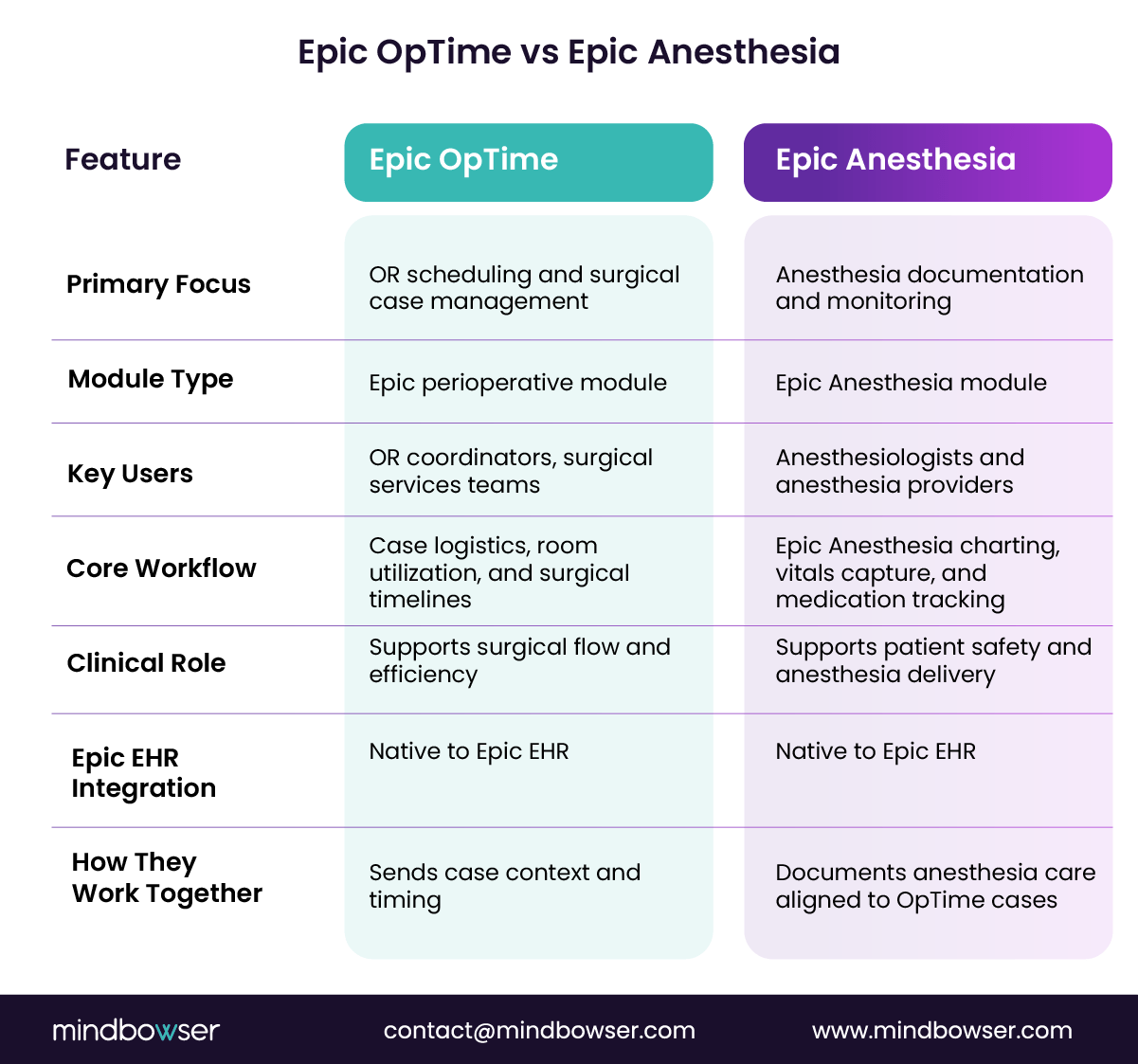
Epic OpTime and Epic Anesthesia are both core Epic modules, but they serve distinct functions within the perioperative environment. Epic OpTime is designed to manage operating room logistics, including case scheduling, room utilization, and surgical workflow coordination. In contrast, Epic Anesthesia focuses on anesthesia-specific clinical documentation, physiologic monitoring, and medication tracking delivered through the Epic Anesthesia module inside the Epic EHR.
While Epic OpTime answers the question “Is the OR running on schedule?”, Epic Anesthesia answers “Is anesthesia being delivered and documented safely and accurately?” Both are mission-critical, but their scopes do not overlap.
B) How They Work Together
Epic Anesthesia and Epic OpTime are designed to operate side by side within shared perioperative workflows. Case data flows from OpTime into Epic Anesthesia, allowing anesthesiology teams to align documentation with surgical events in real time. This integration ensures anesthesia records remain synchronized with OR timelines inside the Epic EHRsupporting smoother handoffs and cleaner downstream reporting.
C) Decision Factors for IT Leaders
For CIOs and CMIOs, the decision is not Epic OpTime or Epic Anesthesia. It is about how to implement both effectively. Epic OpTime addresses operational control, while Epic Anesthesia delivers clinical safety and compliance for anesthesia services. Deployment strategy, training coordination, and data governance across both modules are key to maximizing perioperative value.
Epic OpTime runs the room. Epic Anesthesia runs anesthesia care.
Berita Terkini
Berita Terbaru
Daftar Terbaru
News
Jasa Impor China
Berita Terbaru
Flash News
RuangJP
Pemilu
Berita Terkini
Prediksi Bola
Technology
Otomotif
Berita Terbaru
Teknologi
Berita terkini
Berita Pemilu
Berita Teknologi
Hiburan
master Slote
Berita Terkini
Pendidikan
Resep
Jasa Backlink
Slot gacor terpercaya
Anime Batch