
(Epic Ambulatory + Workflows + Integrations) × Adoption = ROI?
Outpatient care is now the primary growth engine for health systems, but the systems supporting it often lag behind reality. Epic Ambulatory sits at the center of this shift, yet many organizations struggle to extract real value from it.
The issue is not the platform itself; it is how workflows are designed, modules are connected, and clinicians actually use it.
When configured right, Epic Ambulatory becomes more than an EHR module; it becomes the operating system for scalable outpatient care.
I. What Is Epic Ambulatory and Why Does It Matter for Outpatient Care?
Outpatient care is now the center of gravity for health systems. And Epic Ambulatory sits right at the core of it.
Epic Ambulatory is Epic’s dedicated module for managing outpatient and clinic-based care. It is designed for physician practices, specialty clinics, and multi-site ambulatory networks. At its simplest, it handles three things well: clinical documentation, order management, and care coordination. But in practice, it becomes much more.
Think of a typical visit.
A patient checks in, the provider documents the visit, orders labs, sends prescriptions, and schedules follow-ups. How many systems are involved?
With Epic Ambulatory, that entire flow lives within a single system.
It supports:
- Structured visit documentation using SOAP notes and templates
- Order entry for labs, imaging, and medications
- E-prescribing and medication reconciliation
- Longitudinal care plans and problem lists
This consolidation is not just about convenience. It directly impacts outcomes.
According to the CDCthere are over 1 billion physician office visits annually in the U.S.highlighting the scale of outpatient care.
That creates pressure.
- More patients.
- Shorter visit windows.
- Higher documentation burden.
And this is where Epic Ambulatory becomes strategic.
It is no longer just a clinical tool. It is the operating system for ambulatory networks.
When configured well, it improves provider efficiency, reduces errors, and creates a consistent patient experience across locations. When configured poorly, it becomes a source of frustration, clicks, and burnout.
So the real question is not “Do you have Epic Ambulatory?”
It is “Is it actually working the way your clinicians deliver care?”
Epic Ambulatory matters because outpatient care is where revenue grows, margins shrink, and experience is won or lost.
II. What Workflows Does Epic Ambulatory Actually Support?
Epic Ambulatory is not just a module. It is a workflow engine. And the difference between average and high-performing systems comes down to how well these workflows are designed.
Let’s break this down into what actually happens on the ground.
A. Core Clinical Workflows
Every outpatient encounter follows a predictable clinical arc. Epic Ambulatory structures that arc into repeatable, trackable workflows.
At the center is visit documentation.
Providers use templates and SOAP-based formats to capture structured data. This is not just for compliance. It feeds downstream billing, quality reporting, and population health tracking.
Then comes order management.
Labs, imaging, medications. All entered during the visit. When configured well, order sets reduce decision fatigue and speed up care delivery.
Medication reconciliation is another critical component, especially for patients with chronic conditions.
Medication errors harm millions of patients annuallyand in the U.S., estimates commonly cited (including WHO references and supporting studies) point to ~1.3 million injuries per year.
Finally, problem lists and care plans ensure continuity. Not just for one visit, but across the patient’s journey.
But here’s the tension: are these workflows helping clinicians think, or slowing them down?
That depends entirely on the configuration.
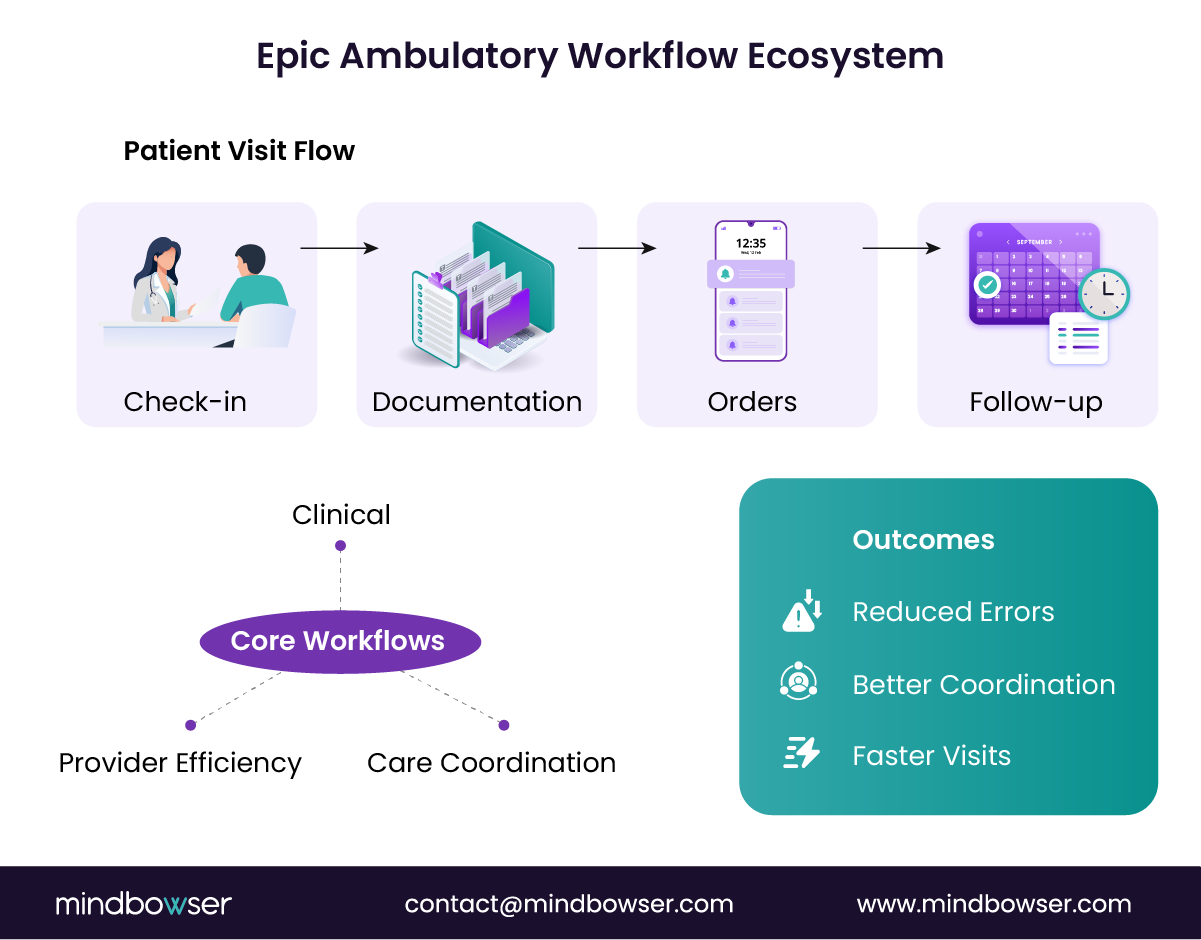
B. Provider Efficiency Workflows
This is where Epic either shines or frustrates.
Epic SmartTools are designed to reduce documentation time:
- Epic SmartTexts for reusable templates
- Epic SmartLists for structured inputs
- Epic SmartLinks to pull real-time data into notes
Used correctly, they can significantly reduce documentation time. Used poorly, they create clutter.
Then there are preference lists.
These allow providers to quickly select commonly used orders. No searching. No scrolling. Just speed.
Add to that clinical decision support.
Alerts, reminders, care gaps. These guides provide evidence-based care. But too many alerts? That leads to fatigue.
Ever seen a provider click through alerts just to move forward?
That is not support. That is noise.
Efficient workflows must reduce clicks, not add them.
C. Care Coordination
Outpatient care is rarely a single-provider event.
Epic Ambulatory supports multi-touch care coordination through:
- Referral management across specialties
- Task routing via in-basket workflows
- Shared visibility across care teams
This matters more than ever.
Studies published in Health Affairs show that effective care coordination can reduce avoidable hospital utilization and improve overall cost efficiencyespecially in high-risk patient groups.
But coordination only works when systems talk to each other.
If referrals are manual…
If messages sit unread…
If data is fragmented…
The entire value breaks down.
Epic Ambulatory creates the structure for coordination. But execution depends on how workflows are wired.
Epic Ambulatory supports clinical care, provider efficiency, and coordination within a single system. But the real impact depends on whether those workflows match how care is actually delivered.
III. Key Epic Modules That Power Ambulatory Workflows
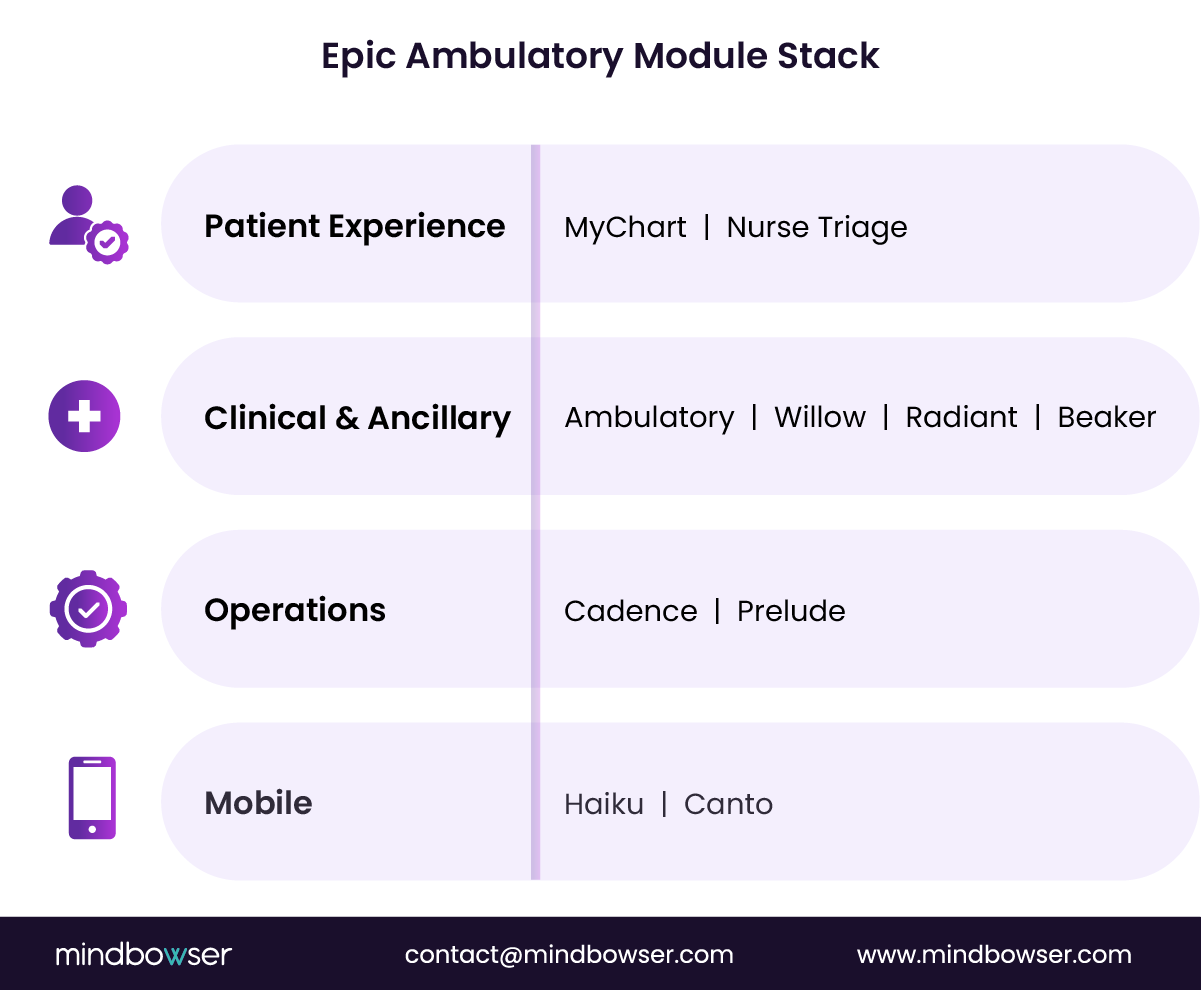
Epic Ambulatory does not work in isolation. Its real strength comes from how tightly it connects with adjacent modules that handle scheduling, diagnostics, pharmacy, and patient engagement.
Think of it as a system of systems.
A. Operational & Scheduling
Epic Cadence is the backbone of outpatient access.
It manages appointment scheduling, provider calendars, and clinic templates. But more importantly, it determines how efficiently patients move through your system.
A poorly configured Cadence setup leads to:
- Long wait times
- Underutilized providers
- High no-show rates
A well-configured one improves throughput without adding staff.
Studies show that no-show rates in outpatient settings can range from 5% to 30%depending on specialty and patient population.
Then comes Epic Prelude.
This handles patient registration and demographic capture. It may seem basic, but errors here cascade downstream into billing, documentation, and reporting.
Incorrect patient data upfront? You pay for it later.
Clean scheduling and registration are not administrative tasks. They are revenue drivers.
B. Pharmacy & Ancillary Integration
Outpatient care depends heavily on diagnostics and medications.
- Epic Willow Ambulatory manages outpatient pharmacy workflows, including e-prescribing. It ensures prescriptions are accurate, trackable, and compliant.
- Epic Radiant handles imaging workflows. From order entry to results reporting, it connects providers with radiology teams.
- Epic Beaker supports lab operations. It manages lab orders, specimen tracking, and results integration.
Together, these modules eliminate fragmentation.
Without them, providers jump between systems. Orders get delayed. Results are missed.
With them, everything flows inside a connected ecosystem.
Imagine ordering labs and not needing to check three systems for results.
That is the difference integration makes.
C. Patient Engagement & Population Health
Outpatient care does not end at the clinic door.
Epic MyChart extends Epic into the patient’s hands. It enables:
- Appointment scheduling
- Secure messaging
- Access to results
This directly impacts engagement.
Studies show that patients who actively use digital portals are more engaged and more likely to adhere to care plansespecially when communication and access are simplified.
Then there is Epic Healthy Planet.
This module tracks population health metrics and identifies care gaps. It supports value-based care initiatives by helping teams manage risk across patient cohorts.
Epic Nurse Triage adds another layer.
It supports call center workflows, helping patients get the right guidance without unnecessary visits.
Care moves from reactive to proactive.
D. Mobile Access for Providers
Providers are not always at a desktop.
Epic Haiku (smartphone) and Epic Canto (tablet) bring Epic workflows into mobile environments. Providers can:
- Review charts
- Respond to messages
- Enter orders on the go
This flexibility matters.
Especially in multi-site ambulatory networks where time and access are fragmented.
Can your providers act on patient needs between visits?
If yes, care speeds up. If not, delays stack up.
Epic Ambulatory delivers value only when these modules work together. The real ROI comes from integration, not just activation.
IV. Where Most Epic Ambulatory Implementations Fail
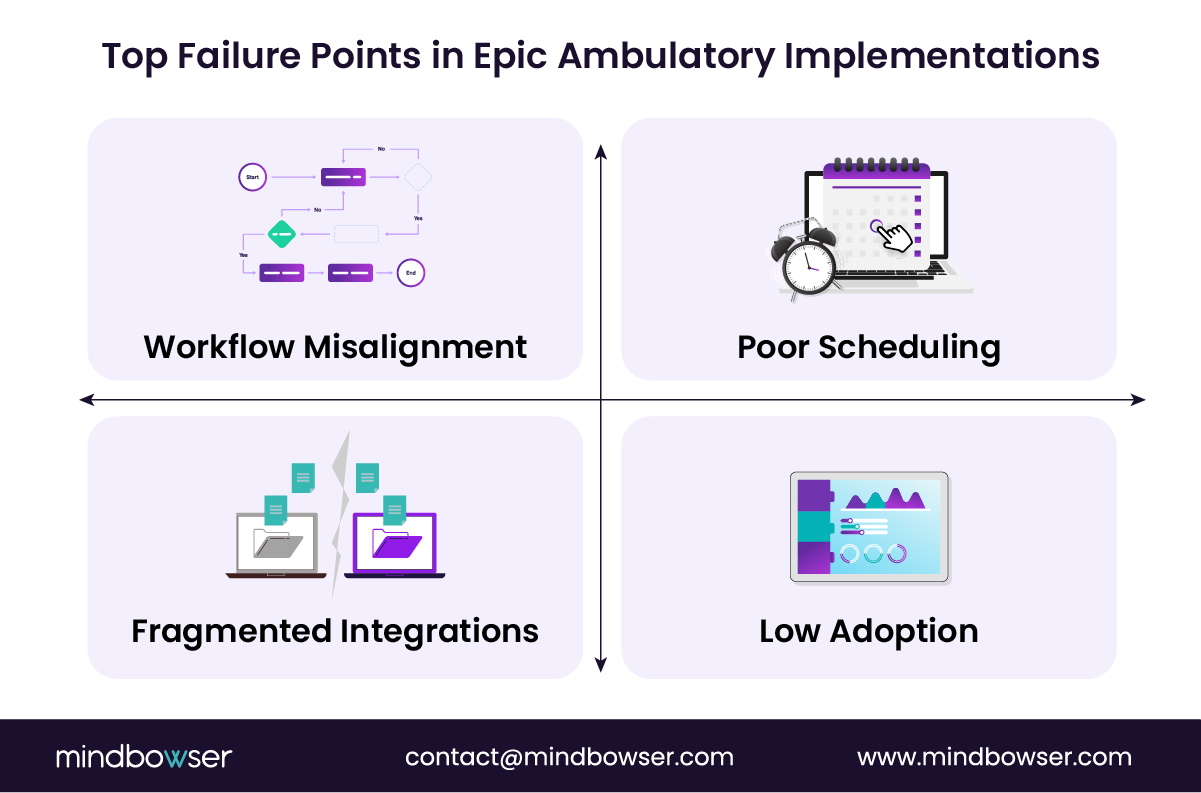
Most Epic Ambulatory challenges are not technical. They are operational. The system works. The problem is how it is configured, adopted, and aligned to real-world care delivery.
Let’s break down where things go wrong.
A. Workflow Misalignment
This is the most common failure point.
Organizations deploy generic templates across specialties. Cardiology, orthopedics, and primary care. All are forced into similar documentation structures.
That does not work.
A cardiologist managing complex cases should not document like a primary care physician handling routine visits. Right?
Without specialty-specific builds:
- Documentation becomes inefficient
- Clinical nuance gets lost
- Providers create workarounds
Worse, clinicians are often not involved early in the design process.
That leads to systems that look good on paper but fail in practice.
If workflows do not match clinical reality, adoption drops.
B. Poor Scheduling Optimization
Cadence is powerful. But most organizations use only a fraction of their capabilities.
Common issues include:
- Static scheduling templates
- No differentiation between visit types
- Limited use of predictive scheduling
The result?
Empty slots on some days—overbooked clinics for others.
And then there are no-shows.
Without automated reminders, overbooking strategies, or access optimization, they remain a persistent problem.
Are your schedules built for reality or assumptions?
That answer shows up directly in revenue.
C. Fragmented Integrations
Epic Ambulatory is designed to connect with labs, imaging, and pharmacy systems. But many implementations leave these integrations incomplete.
What happens then?
- Providers manually enter data
- Results are checked across multiple systems
- Duplicate work increases
This creates operational drag.
And every manual workaround increases the chance of error.
Integration is not optional. It is foundational.
D. Low Provider Adoption
This is where everything comes together.
- Too many clicks.
- Too many alerts.
- Too much friction.
Providers disengage.
A study published found that physicians spend nearly 2 hours on EHR tasks for every 1 hour of direct patient care.
That imbalance drives burnout.
When Epic Ambulatory is poorly configured:
- Documentation time increases
- Alert fatigue sets in
- Satisfaction drops
If your providers are clicking more than they are caring, something is broken.
Epic Ambulatory failures are rarely about the system itself. They stem from misaligned workflows, weak scheduling design, incomplete integrations, and poor adoption strategies.
Fix those, and the same system starts delivering value.
PakarPBN
A Private Blog Network (PBN) is a collection of websites that are controlled by a single individual or organization and used primarily to build backlinks to a “money site” in order to influence its ranking in search engines such as Google. The core idea behind a PBN is based on the importance of backlinks in Google’s ranking algorithm. Since Google views backlinks as signals of authority and trust, some website owners attempt to artificially create these signals through a controlled network of sites.
In a typical PBN setup, the owner acquires expired or aged domains that already have existing authority, backlinks, and history. These domains are rebuilt with new content and hosted separately, often using different IP addresses, hosting providers, themes, and ownership details to make them appear unrelated. Within the content published on these sites, links are strategically placed that point to the main website the owner wants to rank higher. By doing this, the owner attempts to pass link equity (also known as “link juice”) from the PBN sites to the target website.
The purpose of a PBN is to give the impression that the target website is naturally earning links from multiple independent sources. If done effectively, this can temporarily improve keyword rankings, increase organic visibility, and drive more traffic from search results.